
“A lot of things that looked like moats were actually just incumbent inertia...those moats turn out to be made of sand. They were never moats; they were just lack of better options.”- Chamath Palihapitiya
Investors love the word “moat” because it implies safety. It’s a clean, intuitive concept that promises certainty in an uncertain market. But most perceived moats are far more fragile than the pitch decks suggest.
Great Products vs. Great Businesses
A common mistake I have seen—and experienced—in investing is assuming that a product you love equals a business that’s protected. Investors tend to mistake our own positive user experience for a durable competitive advantage.
But a moat isn’t about being “good”, it’s about being defensible.
To find the real moat, an investor must look past the UI and ask the uncomfortable questions: How sustainable is this demand? Does the company have the power to raise prices without losing customers? How easily can a well-funded competitor clone this tomorrow? If you don’t have a solid answer, you don’t have a moat; you just have a popular product.
“The single most important decision in evaluating a business is pricing power. If you’ve got the power to raise prices without losing business to a competitor, you’ve got a very good business. And if you have to have a prayer session before raising the price by a tenth of a cent, then you’ve got a terrible business.” – Warren Buffett
Why the Old Playbook is Breaking
Historically, moats were identified by looking at return on capital. It was math-heavy and reliable. But in an era of software and “intangible” assets, that framework appears to be cracking (see the recent drop on SaaS business as an example).
Code, data, and networks don’t always sit neatly on a balance sheet. This creates a visibility problem: the numbers might look great while the underlying economics are rotting. Modern moat analysis is less about solving a formula and more about understanding the “plumbing” of how a business captures value.
The PayPal Lesson: When Scale Isn’t Enough
PayPal is the ultimate cautionary tale for “moat erosion.” On paper, the narrative was bulletproof: 400 million users, massive merchant adoption, and high conversion rates.
And yet, the fortress crumbled because PayPal was built for a browser-based world. When commerce shifted from “clicking a button” to “tapping a phone,” PayPal hit a brick wall: the hardware.
Because Apple and Google own the operating systems, they control access to the NFC chip—the tiny antenna that makes “Tap to Pay” possible. While Apple Pay integrated seamlessly into the physical world, PayPal was relegated to being a “browser-only” solution. For the consumer, the choice became binary: use the wallet that works everywhere or use the one that only works on half of those. By being locked out of the hardware layer, PayPal didn’t just lose a feature—it lost the battle for the consumer’s primary wallet.
That single technical constraint didn’t just slow them down; it fundamentally broke their advantage in the most valuable part of the payment ecosystem.
Adobe: The Muscle Memory Trap
Adobe is another example of how a “habit-based” moat can suddenly come under attack. For decades, Adobe’s dominance wasn’t just about software: it was about muscle memory. If you were a creative professional, you spent years mastering the complex menus and keyboard shortcuts of Photoshop and Illustrator. That investment created a massive switching cost; leaving Adobe meant learning a new language.
And yet, the walls are thinning. Why? Because Adobe was built for a world of manual craft. When the industry shifted toward AI, the “interface” began to collapse from a thousand precise clicks into a single text prompt.
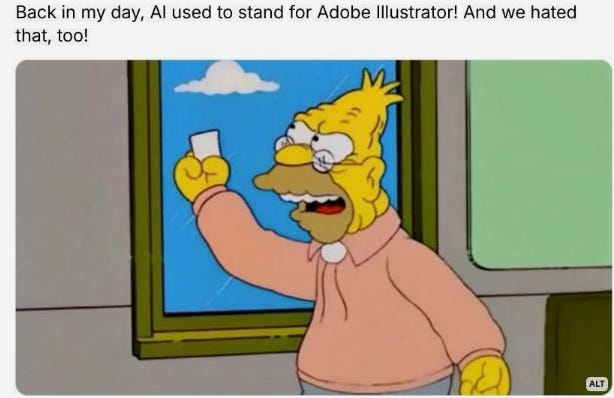
As AI tools allow users to “describe” an image rather than “build” one, the years of expertise required to navigate Adobe’s ecosystem are being commoditized. Adobe is now forced to integrate these same AI tools just to stay relevant, but in doing so, they are effectively dismantling their own barrier to entry. That shift in how we create didn’t just introduce new competition, it threatened to erase the “expert” advantage that kept professionals locked in for thirty years.
Stop Overrating Network Effects
“Network effects” has become the one of the most overused buzzword in the industry, Because it was so successful in explaining the rise of companies like Facebook, it started to be used everywhere, even in companies that just had “scale” but no real defensibility (It reminds me of the ‘SoLoMo’ (Social-Local-Mobile) craze of 2011—a catchy acronym that convinced investors that apps with lots of users automatically had a business model).

It was effectively a mental shortcut for “this company is a winner.” But not all networks are created equal.
In PayPal’s case, the network stayed huge, but the value per user tanked as better alternatives emerged. If a network doesn’t move the needle on user experience every single day, it’s not a moat. It’s just scale. And scale without defensibility is just a big target for competitors.
The Infrastructure Advantage
On the flip side, look at Visa and Mastercard. They’ve faced decades of regulation, lawsuits, and “disruptive” fintech startups, yet their position is as strong as ever.
Their secret? They aren’t just a network; they are infrastructure. They are the global central nervous system for money. Replacing a social network is hard; replacing the literal pipes that connect every bank on the planet is nearly impossible. That is what true durability looks like.
The Bottom Line
A moat isn’t a snapshot of what a business looks like today. It’s a prediction of what a business can defend ten years from now.
Real moats require structural advantages, things like high switching costs or specialized infrastructure, rather than just being the “coolest” brand in the category. Popularity is temporary; structure is (more) permanent.
At the end of the day, investing is about closing the gap between the story and the reality. Don’t only ask if a company is growing fast. Ask: What breaks this? What happens when the environment shifts? If the business only works when things stay exactly as they are, you likely aren’t looking at a moat.
NOTE - This is not investment advice. Do your own due diligence.
I make no representation, warranty, or undertaking, express or implied, as to the accuracy, reliability, completeness, or reasonableness of the information presented in this report. Assumptions, opinions, and estimates expressed in this report constitute my judgment as of the date thereof and are subject to change without notice. Projections are based on a number of assumptions, and there is no guarantee that they will be achieved. K9 Investment Research is not acting as your advisor or in any fiduciary capacity.

K9 Investment Research
Healthcare consultant by trade and investor focused on long-term value creation. I write fundamental deep dives on business quality, unit economics, and valuation.